
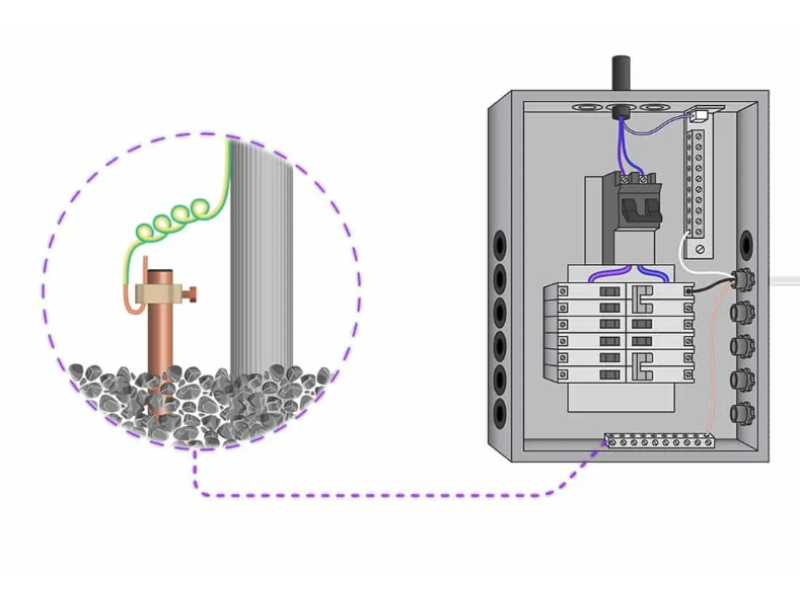
If your apartment lacks a dedicated yellow-green grounding wire, don’t panic. While properly grounding outlets significantly enhances safety when using electrical devices, there are effective alternatives to achieve protection-even in systems without a separate ground wire. In many cases, grounding may not be strictly necessary (for example, in lighting circuits).
Many believe that high-power appliances such as washing machines, electric stoves, or water heaters are inherently more dangerous. In reality, these devices usually feature metal enclosures, which pose a shock risk only if a fault occurs. However, even smaller appliances like hairdryers can be hazardous if their insulation fails. In such cases, traditional grounding might not suffice-but a well-installed Residual Current Device (RCD) will detect leakage currents and promptly disconnect power.
Let’s get back to the primary question: How do you properly ground your apartment?
If the main electrical panel (often called the breaker box) in your building is equipped with a grounding bus, you can boost safety by running an additional ground wire and connecting it to the grounding terminal. Most wiring schemes in modern installations use this method, and sometimes, it’s even acceptable to connect to the neutral bus, provided the neutral is properly bonded to ground at the service entrance. (Keep in mind, the neutral must be reliably grounded at the point of entry.)
If you’re uncertain about the grounding status of your electrical panel, it’s best not to attempt a DIY fix-proper grounding should be part of the system provided by your utility company. Rely on certified professionals to ensure that your system meets all safety standards.
RCD Protection When Grounding Is Absent
For those apartments lacking a dedicated ground wire, installing an RCD (Residual Current Device) is the safest alternative. An RCD monitors the balance of current between the hot and neutral wires. If it detects even a small leakage current (typically around 5-6 mA), it will trip, disconnecting power to protect you from electric shock.
Even without a separate ground conductor, the RCD will provide a measure of safety. For example, if an appliance’s insulation fails and its metal case becomes live, the RCD will sense the leakage current and interrupt the circuit before a dangerous shock occurs.
In some configurations, you might choose not to install an extra ground wire (sometimes called the AB wire). The RCD will still operate if you come into contact with an energized appliance, as its role is to detect and interrupt fault currents. However, until a fault occurs, the RCD does not “see” the phase on the appliance’s metal case. Nonetheless, the safety objective is met, and the risk is minimized.
At safsale.com, we emphasize using high-quality electrical components and following industry best practices to ensure your wiring is safe and reliable. Whether upgrading an older system or installing new wiring, proper grounding-or effective RCD protection when a separate ground isn’t available-is crucial for preventing electrical hazards.
For top-quality grounding supplies and expert advice on electrical safety, visit safsale.com. Ensure your apartment’s electrical system is both safe and compliant with modern standards by choosing trusted products and professional installation practices.