
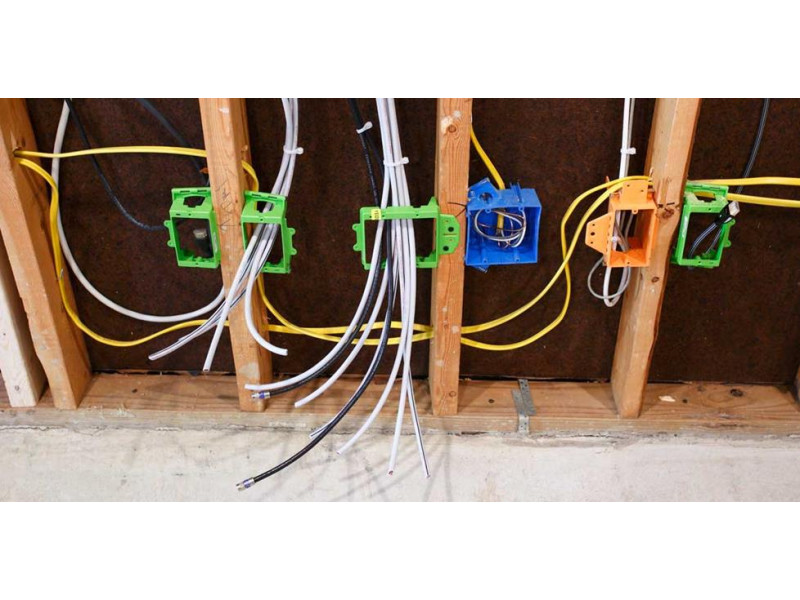
1. Why Cable Choice Matters in Wooden Homes
Unlike brick or concrete buildings, wooden houses pose special fire safety challenges. Wood is combustible, so selecting the correct cable type (with flame-retardant insulation) becomes a top priority. Improper cable selection and installation can lead to overheating, short circuits, or even fires, endangering both property and occupants.
Key considerations when choosing wires for wooden structures:
- Flame resistance to limit ignition risks
- Mechanical durability to withstand wood shrinkage, expansion, or natural movement
- Proper gauge (cross-sectional area) to handle anticipated loads safely
Modern building codes (e.g., in Russia, the PUE – "Правила устройства электроустановок") and various international standards require low-smoke, halogen-free or flame-retardant cables for wood-framed dwellings. This ensures the insulation either self-extinguishes or significantly reduces smoke output in case of a fire.
2. Recommended Cable Types
2.1 VVGng-LS
One of the most popular choices, VVGng-LS is a copper conductor cable with:
- PVC insulation and an outer jacket rated for low smoke (LS) release
- "ng" (негорючий) means flame-retardant
- Handles both open and concealed wiring
Advantages:
- Strong mechanical protection
- Good flexibility, easing installation
- More budget-friendly than many specialized cables
- Service life of 25+ years if installed correctly
2.2 NYM
Another excellent option is NYM cable, originally developed for use in European markets. It features:
- Copper conductors with dual PVC insulation
- An inner rubber filler for improved moisture and impact resistance
- Comparable or superior mechanical strength
Where to use:
- Ideal for both surface and hidden wiring in wooden homes
- Performs well in conditions where additional protection from moisture is needed
3. Determining the Right Cable Gauge
3.1 Estimating Load Requirements
- List all planned appliances (lights, sockets, heavy-load devices).
- Sum the total wattage and apply a coincidence factor (~0.7–0.8) to account for not all devices running at max power simultaneously.
- Convert total load (W) to amps by dividing by the supply voltage (e.g., 220–230 V).
Example: If the total load is 4 kW and voltage is 220 V, the current is roughly 18 A. Adding future capacity or safety margins is prudent.
3.2 Typical Cable Cross-Sections
Below are general guidelines for copper cable sizing in wooden homes:
| Application | Typical Cable Size |
|---|---|
| Lighting Circuits | 1.5 mm² |
| General Outlets | 2.5 mm² |
| High-Load Outlets | 4–6 mm² |
| Electric Stove | 4–6 mm² (sometimes 10 mm² for very high power) |
| Water Heater (Boiler) | 4–10 mm² (depends on capacity) |
| Main Supply Feed | 6 mm² or more (often used for distribution lines) |
Always verify these values with local regulations and manufacturers’ data. Adding a margin is recommended to accommodate future expansions and to keep voltage drop minimal over longer runs.
4. Installing Cables in a Wooden Home
4.1 Open vs. Concealed Wiring
Open Wiring:
- Cables run on the surface in protective raceways or conduits
- Simplifies inspection and maintenance
- Aesthetics can be managed using retro-style or decorative conduits
Concealed Wiring:
- Cables hidden within walls, ceilings, or floor cavities, often in metal conduits
- Minimizes visual impact but complicates repairs or replacements
- Must adhere to strict fire safety codes (e.g., metal piping, sealed joints)
4.2 Fire Safety Essentials
- Use Non-Combustible Enclosures
- Metal distribution boxes and junction boxes
- Protective metal grommets when cables pass through wooden beams or studs
- Install Fire-Resistant Sleeves
- Keep cables from contacting bare wood if local code demands it
- Minimum Bending Radius
- Avoid overstressing the cable insulation
Tip: Inspect all cable bends and feed-through points carefully. Any nick or damage to the insulation must be addressed immediately to avoid potential sparks.
5. Operation and Maintenance
- Regular Visual Checks
- Inspect junction boxes, wire clamps, and connectors for wear or overheating
- Thermal Imaging (Annually)
- Identifies hot spots due to loose connections or overloading
- Timely Upgrades
- If you add high-power appliances (new electric heater, air conditioning units), recalculate loads and possibly upsize cables or add circuits
6. Key Takeaways
- Prioritize Fire Safety: Use cables labeled “ng-LS” (flame-retardant, low-smoke) or similarly certified.
- Appropriate Gauge: Ensure your chosen wire cross-section matches or exceeds expected load demands.
- Proper Installation: Decide between open or concealed methods based on aesthetics, maintenance, and code.
- Periodic Inspections: Conduct routine checks to catch wear and tear before it causes a hazard.
By combining reliable cable types (like VVGng-LS or NYM) with correct sizing and adherence to fire safety codes, you can ensure your wooden home remains secure and comfortable for decades.
Where to Find Quality Cables?
At safsale.com, we offer:
- Flame-retardant copper cables (VVGng-LS, NYM)
- Conduits and fittings for both open and concealed installations
- Protective devices (breakers, GFCIs, surge protectors) to enhance safety
- Expert guidance on cable sizing and fire-safe installation methods
Build a safe, reliable electrical system for your wooden home—visit safsale.com today.
Related products from Safsale
Continue from Academy guidance to live equipment and components available on Safsale.
 Alpha RAP-2150-500 500 Meter Roll of 2 Conductor CableView product
  Windy City/Smart Wire 659116DB-500 Siamese Type RG 59/U Non-Plenum, Direct Burial Cable, 500ftView product
  Alpha CB-7004 1000 ft. 4-Pair 22AWG 7000 Series WireView product
  Alpha RAP-2150 100 Meter Roll of 2 Conductor CableView product