
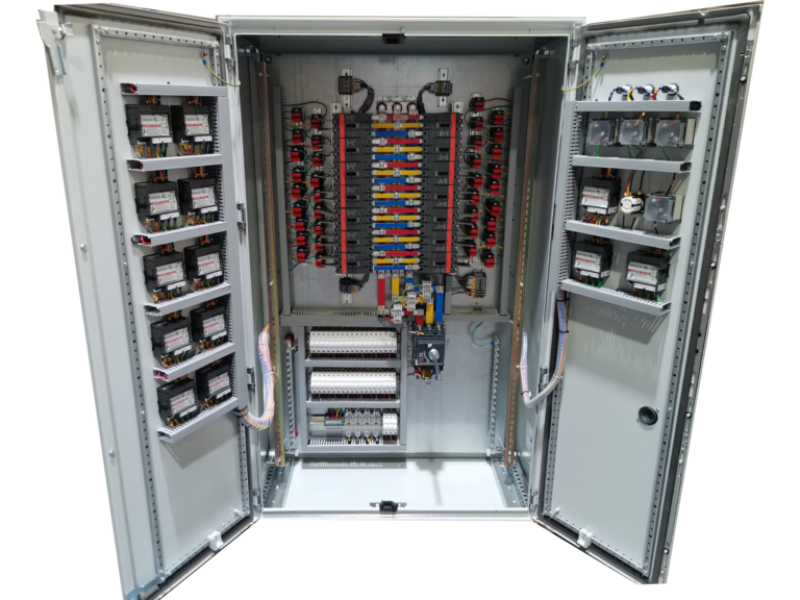
Main Distribution Board (MDB): Role, Types, and Labeling
What Is a Main Distribution Board?
A main distribution board (MDB) is a key electrical device responsible for receiving electricity from the utility grid and distributing it to individual circuits.
Besides power distribution, MDBs often include:
⚡ Power metering
⚡ Circuit protection
⚡ Automatic transfer switching for backup power
MDBs are used in various settings, including:
🏠 Residential homes
🏢 Commercial buildings
🏭 Industrial facilities
The components and configuration of an MDB depend on the size and power requirements of the facility.
Types of Main Distribution Boards
MDBs can be classified based on their function and design:
🔹 By Function:
✔ Incoming Panels - Handle power intake without distribution.
✔ Incoming Panels with Automatic Transfer Switch (ATS) - Switch to backup power automatically.
✔ Distribution Panels - Distribute power to multiple circuits.
✔ Combination Panels (Incoming + Distribution) - Both receive and distribute power.
🔹 By Installation Type:
✔ Wall-mounted (Compact) - Suitable for smaller buildings.
✔ Floor-standing (High-Capacity) - Used in industrial settings.
🔹 By Protection Level:
🏠 Indoor MDBs - Installed inside buildings.
🌦 Outdoor MDBs - Weatherproof enclosures for external installations.
🔹 By Accessibility:
✔ Single-Sided Access - Standard for homes and offices.
✔ Double-Sided Access - Allows maintenance from both sides.
🔹 By Power Supply Configuration:
✔ Single-input MDBs - Connected to a single power source.
✔ Dual-input MDBs - Receive power from two independent feeders for redundancy.
Key Components of an MDB
1️⃣ Main Circuit Breaker
📌 Function:
- Disconnects the entire power system during maintenance or electrical overloads.
- Can be a manual switch (isolator) or an automatic circuit breaker.
2️⃣ Power Meter (Energy Monitoring Device)
📌 Function:
- Tracks electricity consumption for billing and efficiency monitoring.
3️⃣ Circuit Breakers for Individual Circuits
📌 Function:
- Protects circuits and appliances from short circuits and overloads.
✅ Types of Circuit Protection Devices:
- MCBs (Miniature Circuit Breakers) - Protect against short circuits.
- RCDs (Residual Current Devices, a.k.a. GFCIs) - Detect leakage currents to prevent electrocution.
- RCBOs (Residual Current Breakers with Overcurrent) - Combine overload and leakage protection.
MDB Labeling System (How to Read MDB Codes)
Factory-produced MDBs are labeled according to American standards, following ANSI/NEMA PB 1.1 (Panelboards), NFPA 70 (National Electrical Code), and UL 67 (Panelboards).
📌 Example Code: MDB X1XX2X3X4X*5
Decoding the Label:
🔢 1st Digit - Model Number
Defines the specific series or revision of the MDB.
🔢 2nd Digit - Panel Type:
- 11-19: Incoming panels
- 21-29: Combined incoming-distribution panels
- 41-50: Distribution panels
🔢 3rd Digit - Switchgear Type on Input:
- 0: No switching device
- 1: 250A switch
- 2: 400A switch
- 3: 630A switch
- 4: 630A circuit breaker
- 5: Two 250A circuit breakers
- 6: 250A circuit breaker
- 7: 100A circuit breaker + ATS
- 8: 250A circuit breaker + ATS
- 9: 160A circuit breaker + ATS
🔢 4th Digit - Additional Features:
- 0: No extra features
- 1: Automatic lighting control (30 groups)
- 2: Manual lighting control (30 groups)
- 3: Automatic lighting control (14 groups)
- 4: Manual lighting control (14 groups)
- 5: Automatic lighting control (8 groups)
- 6: Manual lighting control (8 groups)
🔢 5th Digit - Protection Type on Outgoing Circuits:
- Blank: Uses fuses
- A: Uses circuit breakers
📌 Note: In the U.S., MDB standards reference UL 891 (Dead-Front Switchboards) and NEMA PB 2 (Dead-Front Distribution Switchboards).
Installation and Safety Guidelines
Step 1: Choosing the Right MDB
✅ Determine the building’s total power load.
✅ Select protection devices based on expected loads.
✅ Ensure expansion capability for future power needs.
Step 2: Proper Placement of the MDB
📌 For Residential & Commercial Installations:
- Install in a dry, ventilated room.
- Maintain clearances for easy maintenance and safety.
📌 For Industrial Applications:
- Install in dedicated electrical rooms with cooling systems.
- Use NEMA 3R or NEMA 4 enclosures for outdoor setups.
Step 3: Wiring & Protection Setup
✔ Use UL-certified wiring and grounding.
✔ Follow NEC (National Electrical Code) for installation.
✔ Ensure short-circuit protection for all circuits.
FAQ: Understanding Main Distribution Boards
1️⃣ What’s the Difference Between an MDB and a Load Center?
📌 An MDB is the primary power hub for an entire facility.
📌 A load center (breaker panel) is typically for home or small office use.
2️⃣ Can an MDB Be Installed Outdoors?
✅ Yes, but it must have a weatherproof enclosure rated NEMA 3R, NEMA 4, or higher.
3️⃣ What Is an ATS (Automatic Transfer Switch)?
📌 An ATS ensures uninterrupted power by switching between main and backup sources.
📌 Used in hospitals, data centers, and industrial plants.
4️⃣ How Do I Know If My MDB Needs an Upgrade?
🚨 Signs of an overloaded MDB:
⚠ Frequent breaker trips
⚠ Insufficient capacity for new electrical loads
⚠ Outdated fuses instead of circuit breakers
Conclusion: Why Proper MDB Selection Matters
✅ The main distribution board (MDB) is the backbone of any electrical system.
✅ Proper selection of circuit breakers, ATS, and wiring ensures system stability.
✅ Marking standards like UL 891 & NEMA PB 2 help identify reliable MDBs.
✅ Routine maintenance extends the life of the electrical infrastructure.
📌 Takeaway: For residential, commercial, and industrial needs, choosing the right MDB is crucial for power safety and efficiency! ⚡