
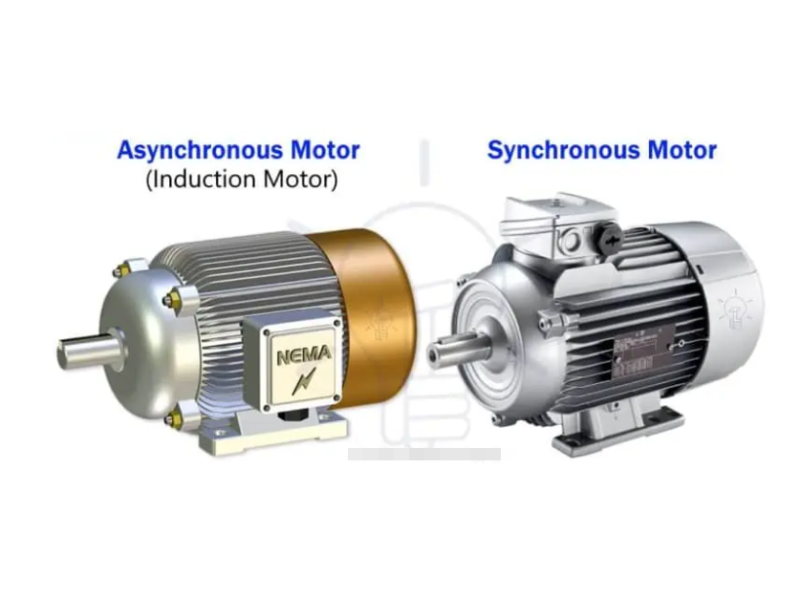
Asynchronous vs. Synchronous Motors: Construction, Function & Use Cases
Asynchronous (Induction) and Synchronous motors are the two main types of AC motors used in industrial, commercial, and household applications. Both share a similar stator-rotor construction, but they differ significantly in operating principles, efficiency, and application areas.
This article explores the key differences between these motors, their advantages, and where each type is best suited.
What Are Asynchronous and Synchronous Motors?
Both motor types convert electrical energy into mechanical motion using electromagnetic fields. However, their rotational speed and interaction with the stator's magnetic field set them apart.
✔️ Asynchronous (Induction) Motor
Rotor speed is lower than the stator’s rotating magnetic field (RMF).
Operates based on electromagnetic induction without external excitation.
Commonly used in fans, pumps, conveyors, and compressors.
✔️ Synchronous Motor
Rotor speed is equal to the RMF speed (zero slip).
Requires external DC excitation for its rotor field.
Used in high-precision applications like industrial drives and power factor correction.
Simply put, asynchronous motors work without an external power source for the rotor, while synchronous motors require one.
1. Key Structural Differences
Both motor types consist of:
✔ Stator – A stationary part containing copper windings that generate a rotating magnetic field.
✔ Rotor – A rotating component interacting with the stator's field to produce motion.
However, their rotor designs and operation differ significantly.
✔️ Asynchronous Motor Rotor Types
1. Squirrel Cage Rotor
✔ Made of conductive bars shorted at both ends
✔ Simple, reliable, and widely used in most AC motors
2. Wound Rotor (Slip Ring Rotor)
✔ Uses external resistors to control torque and speed
✔ Found in industrial applications needing controlled startups
Most asynchronous motors use the squirrel cage rotor because of its simplicity and durability.
✔️ Synchronous Motor Rotor Types
1. Electromagnetic Rotor
✔ Requires external DC excitation to generate its magnetic field
✔ Uses slip rings and brushes to supply current
2. Permanent Magnet Rotor
✔ Uses pre-installed magnets instead of electromagnets
✔ Found in modern servo motors, industrial automation, and wind turbines
Synchronous motors need external excitation to function, unlike induction motors that operate on electromagnetic induction.
2. Working Principle: How Each Motor Operates
✔️ How an Asynchronous (Induction) Motor Works
1. When AC voltage is applied to the stator, it generates a rotating magnetic field (RMF).
2. This RMF induces current in the rotor, creating its own magnetic field.
3. The rotor experiences a force due to electromagnetic interaction, causing it to rotate.
4. Rotor speed is always lower than the RMF speed due to slip, which is necessary for induction to occur.
Induction motors are self-starting and widely used due to their simplicity.
✔️ How a Synchronous Motor Works
1. The stator generates a rotating magnetic field like in an induction motor.
2. The rotor is powered by DC excitation from an external source, creating its own steady magnetic field.
3. The rotor locks onto the RMF and spins at exactly the same speed, resulting in zero slip.
4. Synchronous motors require an external starter mechanism (e.g., damper windings or a separate motor) to reach synchronous speed.
Synchronous motors offer precise speed control but require additional components to operate.
3. Efficiency & Performance Comparison
| Feature | Asynchronous Motor | Synchronous Motor |
|---|---|---|
| Slip | Yes (3-8%) | No (0%) |
| Self-Starting | Yes | No (needs external starter) |
| Speed Regulation | Poor under load | Excellent |
| Efficiency | Lower (energy loss due to slip) | Higher (no slip loss) |
| Power Factor | Lagging (draws reactive power) | Leading or Unity (can improve PF) |
| Cost | Cheaper | More expensive |
| Maintenance | Low | Higher (due to excitation system) |
Asynchronous motors are cheaper and easier to maintain, while synchronous motors offer precise speed control and power factor correction.
4. Applications: Where Each Motor is Used
✔️ Where Asynchronous Motors Are Used
✅ Fans, Pumps, & Compressors – Low cost, reliable operation
✅ Conveyor Belts & Elevators – Rugged design for continuous use
✅ HVAC Systems – Efficient air circulation motors
✅ Household Appliances – Washing machines, refrigerators, and air conditioners
Induction motors are ideal for applications requiring durability and minimal maintenance.
✔️ Where Synchronous Motors Are Used
✅ Industrial Automation & Robotics – Precise speed control
✅ Power Plants & Grid Stabilization – Used for power factor correction
✅ Mills, Crushers, & Large Industrial Equipment – High torque applications
✅ Electric Vehicles & Wind Turbines – Permanent magnet synchronous motors (PMSM)
Synchronous motors are best for high-precision, high-efficiency applications.
5. Key Takeaways: Choosing the Right Motor
✔️ When to Choose an Asynchronous Motor
✔ If cost-effectiveness and simplicity are priorities
✔ If variable speed isn’t critical
✔ If low maintenance and durability are needed
Perfect for general-purpose industrial and household applications.
✔️ When to Choose a Synchronous Motor
✔ If precise speed control is required
✔ If energy efficiency and power factor correction matter
✔ If used in heavy industrial loads or renewable energy systems
Ideal for high-performance industrial applications.
6. Conclusion: Which Motor is Better?
Both asynchronous and synchronous motors have their strengths and weaknesses.
✅ For general industrial applications, induction motors remain the go-to choice due to their simplicity, affordability, and reliability.
✅ For specialized applications requiring exact speed control, synchronous motors offer superior performance.
As industries move toward energy efficiency, synchronous motors (especially permanent magnet types) are gaining traction in modern automation and electric vehicle applications.
Related products from Safsale
Continue from Academy guidance to live equipment and components available on Safsale.
 PRL1X1400B42A Pow-R-Xpress PRL1X Panelboard 400 AView product
  Schneider Electric TeSys LE Enclosed DOL Starter 35A 440V ACView product
  PowerPact Model 6 Full Voltage Non-Reversing Motor Control Center 8998SBA003XFSSSView product
  Eaton Crouse-Hinds EBMCFB Combination Single-Speed Non-Reversing Explosionproof Line Starter EnclosureView product