
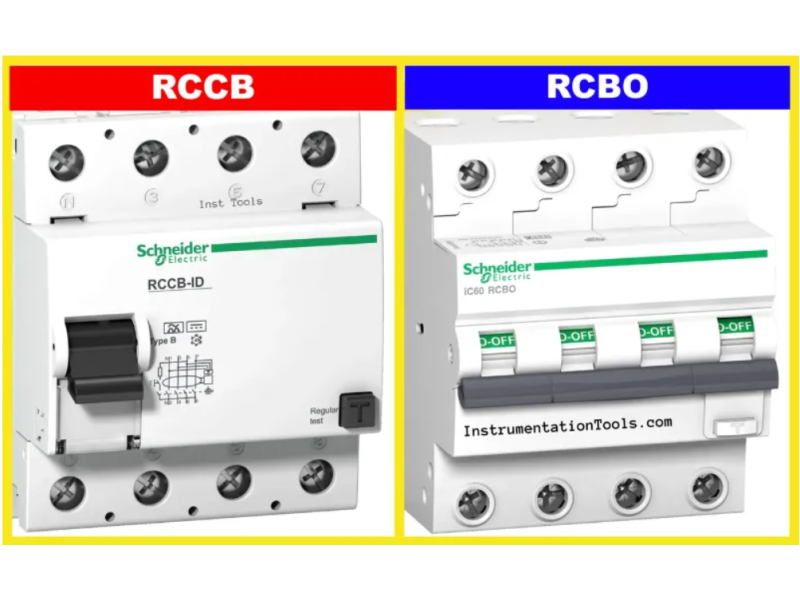
When designing an electrical system for a home or apartment, safety devices are critical. Two common protective devices are DCR (dispositivos residuales actuales) y disyuntores diferenciales. While both serve to disconnect a circuit in case of leakage current, their functionalities differ. At safsale.com, proporcionamos orientación de expertos para ayudarle a elegir el dispositivo adecuado para garantizar que su sistema de cableado cumple con los estándares NEC y mantiene su hogar seguro.
Comprender la diferencia
-
Interruptor diferencial (DiFavtomat):
This device not only trips when current exceeds its rated value due to overload or short circuit but also disconnects the circuit if it detects a differential (leakage) current. In other words, it combines overcurrent protection with residual current protection in one unit. -
RCD (dispositivo residual actual):
Un RCD está diseñado únicamente para monitorear las corrientes de fuga. Desplaza cuando detecta un desequilibrio entre los cables vivos y neutros. A diferencia del interruptor diferencial, un RCD no proporciona protección sobrecorriente, por lo que generalmente se instala junto a un interruptor automático estándar.
Consideraciones clave
-
Protección contra cortocircuitos:
Dado que los RCD sólo reaccionan a corrientes de fuga, debe instalar un interruptor automático (ACB) automático separado para la sobrecarga y protección de cortocircuitos. Esto significa más componentes y espacio de cableado adicional. Interruptores diferenciales, combinando ambas funciones, simplifican la instalación y ahorran espacio. -
Costo:
For example, a budget-friendly RCD might cost around $23.50 (approximately 1,879 RUB), while a differential breaker could be about $19.40 (approximately 1,549 RUB), and a standard circuit breaker might run about $3.35 (aproximadamente 268 RUB).- For a single circuit, a differential breaker is generally more economical since it combines two functions in one device.
- Sin embargo, si está protegiendo varios circuitos, el uso de un RCD con interruptores automáticos separado para cada rama puede ser más rentable.
Esta comparación de precios, procedente de proveedores fiables, muestra que en igualdad de condiciones, los interruptores diferenciales a menudo tienen una ventaja. ?
Consecuencias prácticas
-
Diseño del sistema:
The optimal choice depends on your overall wiring layout. For one circuit, a differential breaker is attractive for its integrated protection. In installations with several circuits, you might achieve cost savings by using one centralized RCD paired with individual circuit breakers. -
Normas de instalación:
Always adhere to NEC (National Electrical Code) guidelines when planning your system. Proper installation ensures that even in fault conditions—such as a broken neutral conductor—the protective devices work as intended. For instance, if the PEN (combined protective earth and neutral) conductor fails, a differential breaker or an RCD becomes critical for preventing hazardous voltage levels on accessible parts. ⚡
Conclusión
There isn’t a one-size-fits-all answer—CCD y disyuntores diferenciales both offer distinct advantages. Differential breakers provide comprehensive protection in a single unit, which is ideal for single-line installations. However, for multiple circuits, an RCD with separate overcurrent breakers might offer better flexibility and cost savings. Your choice should be based on your building’s wiring scheme and safety requirements.
Para recomendaciones a medida y consejos más detallados sobre cómo garantizar instalaciones eléctricas seguras conformes con NEC, visite safsale.comNuestros expertos están aquí para ayudarle a tomar decisiones informadas que maximicen la seguridad y la eficiencia.
Productos relacionados de Safsale
Continúe desde la guía de la Academia a los equipos y componentes en vivo disponibles en Safsale.


