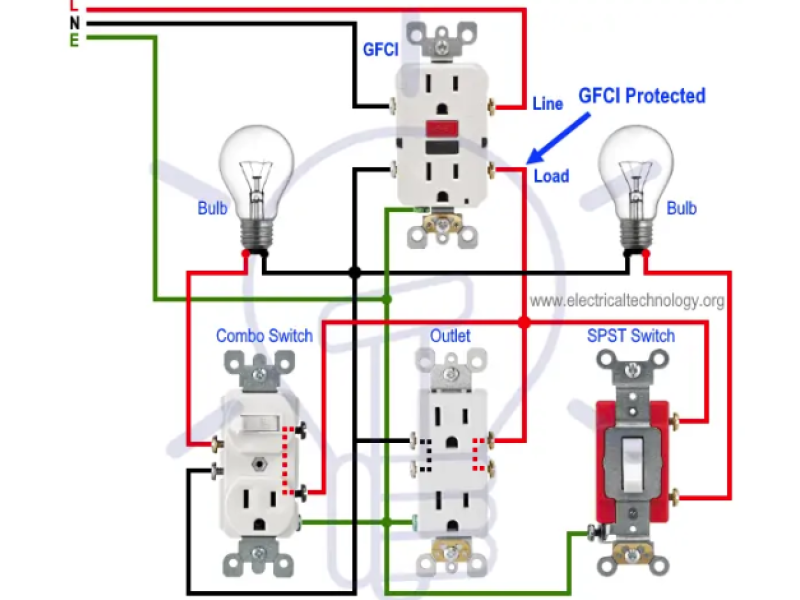
Cómo conectar un GFCI a un sistema eléctrico de fase única
WITHOUT GROUNDING
WITH GROUNDING
Comencemos respondiendo una pregunta frecuente: "¿Funciona un GFCI sin puesta a tierra?"
Yes, it does function, but only when a person touches the device's metal casing that has become energized. In this scenario, the leakage current flows to "ground" through the person's body (see the principle of operation of a Ground Fault Circuit Interrupter or GFCI).
If the device has a trip current below a dangerous level for humans, such as 5 mA o 15 mA, no habrá ningún daño . Sin embargo , el uso de dispositivos calificados para 100 mA o superior puede ser peligroso en tal contacto.
Therefore, installing a GFCI without grounding is possible. This is commonly done in areas where a grounding system is absent, such as:
- Apartments in older residential buildings (e.g., walk-up apartments)
- Cabañas
- Viviendas privadas donde puesta a tierra no fue implementado por razones específicas
Este enfoque es efectivo y beneficioso desde el punto de vista de la seguridad eléctrica, especialmente cuando se utilizan herramientas eléctricas en exteriores 120V.
En mi cabina, instalé un GFCI sin puesta a tierra, y funcionó perfectamente. Lo verifiqué intentando conectar una bomba de pozo durante una tormenta de lluvia usando un cable de extensión (sé que no era el método correcto, pero funcionó).
Interestingly, in this case, the leakage could have flowed to the ground not necessarily through me but also through the wire. The fact remains that this method works and provides protection.
Let's examine the corresponding diagram for a single-phase system and the operational principle of a GFCI in this setup.
In the diagrams, the following symbols are used:
- GFCI: Interruptor de circuito de falla en tierra
- Un solo polo interruptor automático: Protects a single conductor
- Doble polo interruptor automático: Protege dos conductores
CONNECTING A GFCI WITHOUT GROUNDING
First, let's explain how a GFCI operates in a single-phase electrical system without grounding (see Figure 1a).
Cómo funciona un GFCI sin puesta a tierra
The condition for a GFCI not to trip is that the incoming and outgoing currents are equal:
Esta condición se cumple:
- En funcionamiento normal de equipos eléctricos conectados
- When there is a fault to the casing, but no electrical connection between the casing and the "ground"
However, when a person touches a faulty electrical device, their body creates a path for leakage:
Esto perturba el equilibrio actual:
causando que el GFCI se desplome.
Thus, connecting a single-phase GFCI in an ungrounded system is done according to the scheme shown in Figure 1b.
CONNECTING A GFCI WITH GROUNDING
Curiosamente, el método de conexión se mantiene sin cambios cuando puesta a tierra está presente. Sólo el principio operativo difiere, que ahora vamos a explorar.
La figura 2a ilustra cómo funciona un GFCI cuando se conecta a un sistema monofásico con puesta a tierra. Aquí tenemos un sistema TN-C-S puesta a tierra.
Cómo funciona un GFCI con puesta a tierra
In this case, when there is a fault to the casing, a leakage current immediately flows through the PE conductor, bypassing the GFCI:
Esto perturba la igualdad de las corrientes entrantes y salientes:
hacer que el GFCI se desplace independientemente de si la carcasa fue tocada.
In rural homes and cabins, a TT grounding system may be used, where the PE conductor is connected to an individual grounding circuit or rod. There are no significant differences in connecting a GFCI in this scenario (see Figure 2b).
La figura 2b muestra la conexión de un GFCI con un sistema TT puesta a tierra.
Explicaciones adicionales
As you may have noticed, all diagrams include a circuit breaker. This is essential because it's always necessary to protect the electrical circuit (and the GFCI) from short circuits and overloads.
Protective functions in the event of emergency voltage on the casing are not performed by the circuit breaker.
Hay diferencial (doble función) interruptores automáticos que se puede utilizar en lugar de la combinación GFCI-interruptor automático (véase la figura 3).
GFCI y interruptores automáticos de doble función
By the way, all previous diagrams feature a single-pole circuit breaker, as this is the most widely used practice. However, a double-pole breaker can be used if desired, interrupting not only the phase (L) pero también el neutral (N) conductores (véase el lado izquierdo de la figura 3).
Este artículo cubre los principios generales y esquemas de conexión para dispositivos de protección eléctrica monofásica. Basados en estos, cualquier proyecto de cableado eléctrico puede ser implementado sin dificultades significativas.
Pregunta final: "¿Es necesaria una GFCI si hay puesta a tierra?"
There is no definitive answer. However, it's important to consider that with a GFCI present, the circuit is de-energized in an emergency. If there is only one grounding point, the potential difference may equalize, and the GFCI may not trip.
Por supuesto, si el conductor de fase corta a la carcasa del dispositivo, el interruptor automático se tropezará. Sin embargo, si la fuga fluye a través de cierta resistencia, la corriente puede ser insuficiente para activar el interruptor.
In this case, there are at least two problems:
- Continuous power loss – you might wonder why your electric meter shows increased readings
- Calentamiento gradual de cables, que puede conducir a un incendio
Además, si la resistencia puesta a tierra supera los niveles normales por cualquier motivo, la eficacia de protección disminuye. Un GFCI puede detectar incluso corrientes de fuga menores.
Therefore, even with grounding in place, installing a GFCI is advisable.
Para obtener guías más detalladas y productos de seguridad eléctrica de calidad, visite safsale.com.
Notas sobre fórmulas y términos técnicos
Equilibrio actual: El principio fundamental de la operación GFCI es que la corriente entrante (I₁) debe ser igual a la corriente saliente (I₂). Any imbalance indicates a leakage (I₃), incitando al GFCI a viajar.
When a leakage occurs:
Calificaciones actuales del viaje: Los GFCI se clasifican en función de la sensibilidad de sus corrientes de viaje. 5 mA, 15 mA, y 30 mA, con valores más bajos que ofrecen una mayor protección.
Sistemas puesta a tierra:
- Sistema TN-C-S: Combina los conductores de tierra neutros y protectores.
- Sistema TT: Utiliza un electrodo puesta a tierra independiente.
interruptores automáticos:
- Un solo polo: Protege un conductor (típicamente la fase).
- Doble polo: Protege dos conductores (fase y neutro).
Incorporar estas fórmulas y términos técnicos asegura claridad y precisión, haciendo que la guía sea más informativa y confiable para el público estadounidense.
Conclusión
By including the relevant formulas and maintaining technical accuracy, this guide provides a comprehensive and clear understanding of how to install and operate GFCIs in single-phase electrical systems, both with and without grounding. Ensuring proper installation enhances electrical safety, protecting both property and individuals.
Para más información y productos de alta calidad de seguridad eléctrica, no dude en visitar safsale.com
Productos relacionados de Safsale
Continúe desde la guía de la Academia a los equipos y componentes en vivo disponibles en Safsale.