
Understanding Synchronous Motors and Their Operation
Synchronous motors are a type of AC motor where the rotor speed matches the frequency of the stator’s magnetic field. They are widely used in industrial applications that require precise speed control and high efficiency.
This article explores the structure, working principle, advantages, and different starting methods of synchronous motors.
1. What is a Synchronous Motor?
A synchronous motor operates at a constant speed, determined by the supply frequency, according to the formula:
Where:
- = Synchronous speed (RPM)
- = Supply frequency (Hz)
- = Number of poles
Unlike induction motors, which operate with a slip, synchronous motors run at a fixed speed regardless of load variations.
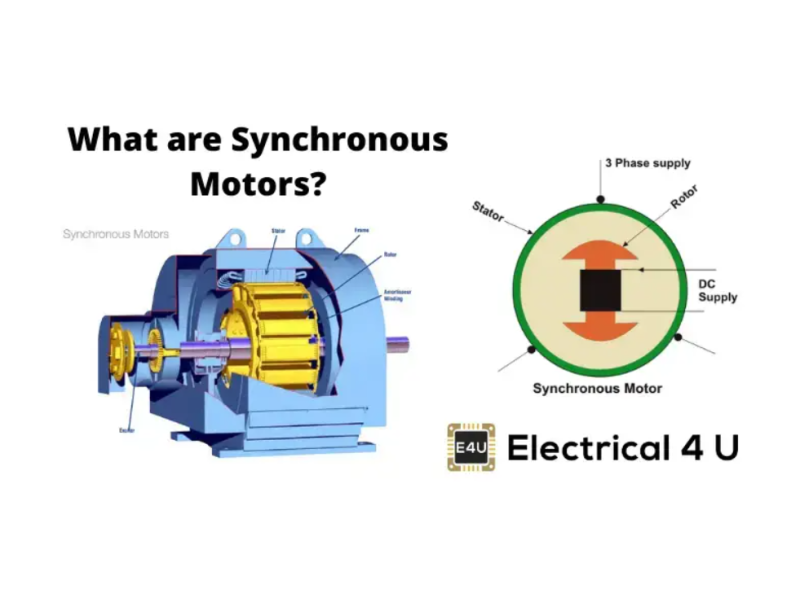
2. Construction of a Synchronous Motor
A synchronous motor consists of the following key parts:
Stator (Stationary Part)
- Contains a three-phase winding
- Produces a rotating magnetic field (RMF) when powered
Rotor (Rotating Part)
- Can be either wound (with field windings) or permanent magnet-based
- Creates its own magnetic field
Excitation System
- Provides DC excitation to the rotor field winding
- Can be supplied via slip rings and brushes or brushless excitation
Contact Brushes (For Wound Rotor Motors)
- Conducts DC current to the rotor winding
- Permanent magnet motors do not need brushes
Frame & Bearings
- Provides mechanical support
- Ensures smooth rotation of the rotor
3. Working Principle of a Synchronous Motor
1. When AC power is applied, the three-phase stator windings create a rotating magnetic field (RMF).
2. The rotor receives DC excitation, creating a magnetic field.
3. The rotor locks in with the stator’s magnetic field and starts spinning at synchronous speed.
4. The motor maintains this speed as long as the load does not exceed its pull-out torque.
Unlike induction motors, synchronous motors do not rely on slip for torque generation.
4. Types of Synchronous Motors
| Motor Type | Excitation Type | Application |
|---|---|---|
| Wound Rotor | Uses DC excitation | Large industrial machines, compressors |
| Permanent Magnet (PMSM) | Uses permanent magnets | Robotics, aerospace, precision control |
| Reluctance Motor | Rotor designed with saliency | Fans, pumps, automation systems |
| Hysteresis Motor | Uses magnetic hysteresis effects | Clocks, record players, small loads |
Permanent Magnet Synchronous Motors (PMSMs) are gaining popularity due to their high efficiency and reliability.
5. Advantages of Synchronous Motors
✔ Constant Speed Operation – No slip, precise speed control
✔ High Efficiency – Less energy loss compared to induction motors
✔ Power Factor Correction – Can operate at leading power factor, reducing grid demand
✔ Better Load Handling – Can handle overload for short durations
Common Uses: HVAC systems, compressors, elevators, industrial conveyors
6. Challenges of Synchronous Motors
❌ Complex Starting Process – Cannot self-start like induction motors
❌ Higher Initial Cost – Requires excitation system
❌ Maintenance Required – Brush-based systems need regular servicing
Solution: Use electronic controllers (VFDs) or advanced starter circuits for smooth operation.
7. How to Start a Synchronous Motor
Since synchronous motors cannot self-start, different methods are used for smooth acceleration:
1. Using an Auxiliary Motor
- A separate small induction motor starts the rotor.
- Once near synchronous speed, DC excitation is applied.
- The motor locks into synchronous operation.
Used in large industrial applications.
2. Damper Winding (Asynchronous Start)
- Rotor has additional short-circuited windings (like an induction motor).
- During startup, the motor runs like an induction machine.
- Once close to synchronous speed, DC excitation is applied to lock in synchronization.
Used in high-power industrial motors.
3. Variable Frequency Drive (VFD) Start
- The best modern solution for soft starting.
- VFD gradually increases frequency from 0 Hz to rated speed.
- Benefits:
Related products from Safsale
Continue from Academy guidance to live equipment and components available on Safsale.
 PRL1X1400B42A Pow-R-Xpress PRL1X Panelboard 400 AView product
  Schneider Electric TeSys LE Enclosed DOL Starter 35A 440V ACView product
  PowerPact Model 6 Full Voltage Non-Reversing Motor Control Center 8998SBA003XFSSSView product
  Eaton Crouse-Hinds EBMCFB Combination Single-Speed Non-Reversing Explosionproof Line Starter EnclosureView product