
📡 Digital TV Antennas: Choosing and Installing for Superior Reception
Digital terrestrial television in the United States is broadcast by transmitters mounted on towers and received in homes and offices using a digital TV tuner. Unlike analog systems, digital signals maintain consistent image quality even with moderate signal loss. Moreover, digital transmission can carry significantly more data-allowing for both standard and high-definition broadcasts. Whether your TV tuner is built into your television or added as a set-top box, receiving a clear digital signal starts with the right antenna.
🔍 Understanding Digital TV Reception
Digital TV signals are transmitted in specific frequency bands. In the U.S., most digital broadcasts use the UHF spectrum-typically between 470 MHz and 698 MHz-which is crucial for receiving DVB-T2 or ATSC 3.0 signals. The antenna you choose must be designed to operate within this frequency range. While many products may also reference terms like “DVB-T2,” “SDTV,” or “HDTV,” the key specification to look for is UHF.
For multi-unit residences, a common (shared) antenna may suffice. However, in a private home or cabin, you’ll need to install your own digital TV antenna to ensure uninterrupted access to over-the-air broadcasts.
📡 Types of Digital TV Antennas
There are several popular designs for receiving digital TV signals, each with unique advantages:
1. Dipole Antennas ("Rabbit Ears")
- Design:
Consists of two conductive elements, typically extendable, each roughly a quarter of the wavelength long. - Features:
These simple antennas are usually omnidirectional in the horizontal plane, making them ideal for indoor setups. - Usage:
Commonly used in rooms where the signal source is nearby and obstacles are minimal.
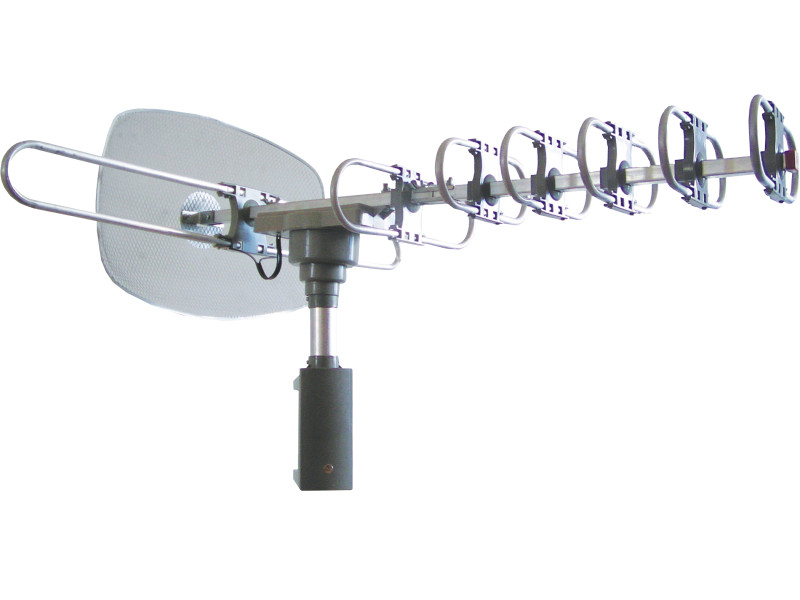
2. Yagi (Wave Channel) Antennas
- Design:
A Yagi antenna features one active element (the driven element) accompanied by passive elements-directors and a reflector-to boost gain. - Performance:
Typically offers gains of 6-12 dB and a narrow beamwidth (around 15-20° if additional directors are used). Higher gain models can reach up to 20 dB, but require precise alignment. - Usage:
Ideal for outdoor installations where a directional focus is needed, especially if the TV transmitter is far away.
3. Log-Periodic Antennas
- Design:
Comprised of multiple dipole elements arranged in order of decreasing size, providing a wide frequency bandwidth. - Performance:
Offers moderate gain (around 6-7 dB) with a wider beamwidth (approximately 60°), making them versatile for capturing signals across a broad range. - Usage:
Suitable for areas where the signal might vary over a range of frequencies or when you need a balance between gain and coverage.
4. Combined (All-Wave) Antennas
- Design:
These antennas combine elements for both VHF and UHF reception. - Usage:
Useful if your location also receives analog signals or if you want flexibility to cover a broader range of channels.
🔧 Installation and Connection Tips
Antenna Placement
- Optimal Location:
For the best signal reception, place your antenna where it has a clear view of the TV transmitter. This could be near a window on the second story or mounted on the roof. In rural areas or where buildings and trees obstruct the signal, a higher mast may be required. - Alignment:
Directional antennas like Yagi and log-periodic types must be accurately pointed toward the transmitter. Use online tools or smartphone apps to determine the direction of the nearest broadcast tower.
Connecting the Antenna
- Cable Selection:
Connect your antenna to your TV or set-top box using a high-quality coaxial cable. In the U.S., these cables typically have a characteristic impedance of 75 ohms. - Minimize Losses:
Keep the cable run as short as possible to reduce signal loss, and avoid unnecessary connectors and splices. If you must extend the cable, use proper adapters (such as pig-tail connectors) that match the 75-ohm standard.
Additional Considerations
- Weather and Obstructions:
For outdoor antennas, ensure they are securely mounted and weatherproof. Consider materials that can withstand rain, wind, and temperature fluctuations. - Aesthetic Integration:
In residential settings, discrete antennas that blend with the home’s exterior can be a plus without sacrificing performance.
🎯 Conclusion
Digital TV antennas are essential for enjoying high-quality over-the-air television in American homes and rural settings. By selecting an antenna that is specifically designed for the UHF band and by understanding the different types-dipole, Yagi, log-periodic, and combined-you can maximize your reception quality. Proper installation, careful alignment, and quality connection cables will ensure you receive a robust signal and enjoy uninterrupted viewing.
At safsale.com, we offer a variety of digital TV antennas engineered to meet American standards. Whether you’re upgrading your home entertainment system or setting up a cabin for remote living, our solutions provide the performance and reliability you need. Upgrade your reception today and experience the difference! 🚀📺🔧