
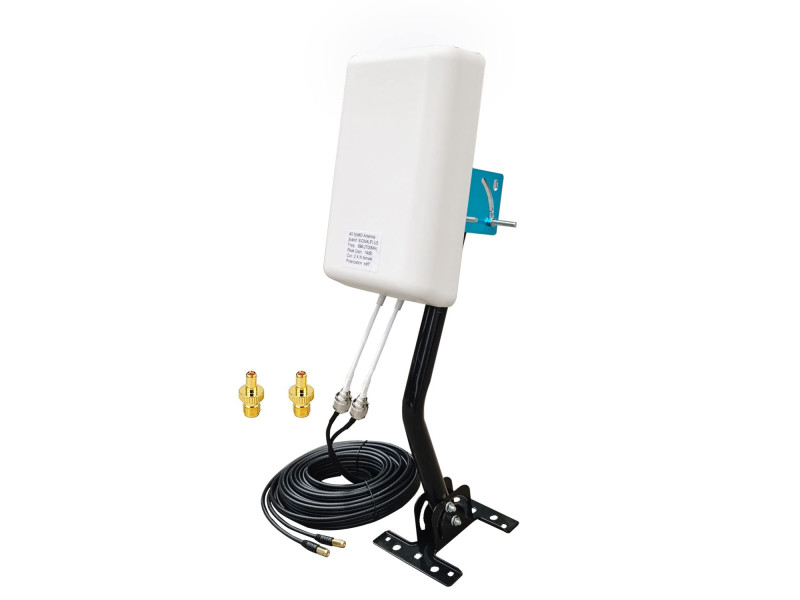
📡 Internet Antennas for Home and Rural Connectivity
Mobile internet has become a necessity in modern life. In the United States, reliable wireless internet access is no longer a luxury but a must-have for everything from everyday communications to smart home applications. However, when you’re away from urban centers-say, at a rural cabin or a vacation property-getting a strong signal can be challenging. Fortunately, the right internet antenna can make all the difference.
At safsale.com, we offer a wide range of internet antennas engineered to meet American standards, ensuring that you stay connected even in remote locations. This article explores the various wireless technologies, antenna types, connection methods, and installation considerations to help you choose the best solution for your home or cabin.
📶 Overview of Wireless Internet Technologies
Wireless communication is typically categorized by “generations” (G - generation). Here's a brief overview:
- 1G: Analog systems with extremely low data rates (around 2 kbps)
- 2G: Digital cellular networks, primarily GSM, supporting speeds up to about 474 kbps
- 3G: Transition to CDMA-based systems (e.g., UMTS, HSPA) with speeds up to 42 Mbps
- 4G (LTE): Modern high-speed networks capable of speeds up to 1 Gbps
With each generation, data transmission capabilities have improved, making mobile internet a crucial component of modern wireless systems.
Fun Fact:
In the early days of mobile phones, data speeds were so slow that text messaging was the primary data service. Now, 4G networks enable high-speed streaming and real-time video conferencing.
📡 Types of Internet Antennas
Internet antennas convert radio waves into electrical signals and vice versa. Their design and performance depend on key characteristics like bandwidth, directionality, gain, and input impedance. Let’s review the main types:
1. GSM/GPRS Antennas
GSM technology is widely used for cellular communication and data transmission. Most modern devices incorporate GSM modules to access mobile networks.
- Advantages:
- No reliance on fixed telephone lines
- Can be deployed anywhere within cellular coverage
- Compatible with a variety of devices through standardized protocols
- GPRS builds on GSM by allowing packet-based data transmission at speeds up to 171 Kbps, which is suitable for basic internet services and remote monitoring.
Note: In many cases, devices are hybrid-supporting both GSM and GPRS functionalities.
2. WiFi Antennas
WiFi antennas are designed for local wireless networks and are ubiquitous in American households, offices, and public spaces.
- Standards:
- Most WiFi devices operate at 2.4 GHz (though some also use 5 GHz).
- Types:
- Panel (Patch) Antennas: Usually offer 5-10 dB gain with a 40°-60° beamwidth
- Dipole or “Rod” Antennas: Provide omnidirectional coverage, ideal for mobile devices or routers
- Application:
- Enhances WiFi signal strength in homes, offices, or even remote cabins where obstacles or distance from the router may weaken the signal.
3. RF Antennas (434/868 MHz)
For scenarios where WiFi or cellular signals are insufficient, antennas operating in the 434/868 MHz range can be a viable solution.
- Advantages:
- Extended transmission range - in ideal conditions, up to 10 km
- Lower energy consumption, with some devices running for up to 10 years on a single battery
- Better penetration around obstacles due to lower signal attenuation
- Limitations:
- Lower data rates (usually a few hundred kilobits per second)
- Lack of universal standards - manufacturers often use proprietary protocols
Application Example:
These antennas are often used in rural access systems, remote monitoring setups, and specialized applications like wireless access control or IoT devices.
4. MIMO Antennas
MIMO (Multiple Input Multiple Output) technology uses two or more antennas to improve data throughput and reliability.
- Example:
A MIMO 2×2 antenna setup consists of two antennas positioned at 90° to each other. This configuration enhances signal quality and network speed-critical for areas with weak signals or high interference. - Benefits:
- Increased speed and reliability
- Better handling of multipath interference
🔌 Installation and Integration
Connecting the Antenna to Your Device
Your antenna connects to a modem or router via a feeder cable (also known as a coaxial cable). Here are some key points:
- Feeder Cable:
Use a coaxial cable with a characteristic impedance of 50 ohms for most cellular, WiFi, and RF systems. (Some TV antennas use 75 ohm cables, but these require proper matching.) - Connectors:
The connectors must match the cable’s impedance. For example, using connectors marked as 50 Ω ensures minimal signal loss. - Cable Length:
Signal loss increases with cable length. Use high-quality cables and minimize connectors (e.g., using a pig-tail adapter for USB modems) to reduce attenuation.
Mounting Considerations
For optimal performance:
- Placement:
Antennas should be installed where the signal is strongest. For rural homes or cabins, mounting the antenna near a window on an upper floor or on a mast can significantly improve reception. - Alignment:
Directional antennas like panel or Yagi antennas require careful alignment toward the nearest cell tower or base station. - Maintenance:
Ensure the antenna is securely mounted and accessible for maintenance (e.g., removing ice, adjusting position).
🌟 Conclusion
Wireless internet access is essential in modern American life-whether in urban centers or at rural cabins. Choosing the right internet antenna can make a significant difference in your connectivity. From GSM/GPRS for mobile communication to WiFi for local networks and RF antennas for long-range applications, each type has its strengths and limitations. Additionally, advanced technologies like MIMO further enhance connectivity in challenging environments.
At safsale.com, we offer a full range of internet antennas designed to meet U.S. standards, ensuring robust, reliable wireless communication for your home or cabin. Upgrade your connectivity today and enjoy seamless internet access, no matter where you are 🚀📶🔧
Explore our selection now and experience the best in wireless antenna technology!