
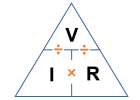
Ohm’s Law for Electrical Circuits: Understanding Current, Voltage & Resistance
1️⃣ What is Ohm’s Law?
Ohm’s Law is the fundamental principle of electricity that describes the relationship between:
✔ Voltage (U or V) – the electrical potential difference
✔ Current (I) – the flow of electric charge
✔ Resistance (R) – the opposition to current flow
This law is essential for designing and troubleshooting electrical circuits, from household wiring to industrial electronics.
Example: When you connect a battery to a circuit, the voltage drives the current through the resistance, determining the amount of electricity flowing.
2️⃣ Ohm’s Law Formula
Ohm’s Law is mathematically expressed as:
where:
✔ I – Current (A)
✔ U (or V) – Voltage (V)
✔ R – Resistance (Ω, Ohm)
Variations of Ohm’s Law
You can rearrange the formula to find any missing value:
✔ To find voltage:
✔ To find resistance:
Example Calculation:
A 12V battery is connected to a 6Ω resistor. What is the current flowing?
The circuit has 2 Amps of current.
3️⃣ Ohm’s Law in a Closed Electrical Circuit
For a closed circuit, the formula considers the internal resistance (Rᵢₙₜ) of the power source:
✔ Rᵢₙₜ is the internal resistance of a battery, generator, or power supply
✔ If Rᵢₙₜ is small, it can be ignored in basic calculations
Example: A 9V battery (with Rᵢₙₜ = 1Ω) is connected to a 10Ω resistor. Find the current:
This means 0.82A flows in the circuit, considering battery resistance.
4️⃣ Key Observations from Ohm’s Law
✔ Current is the same at all points in a series circuit
✔ Higher resistance = Lower current
✔ Higher voltage = Higher current
✔ Short circuit current is limited by the internal resistance of the power source
⚡ Example of a Short Circuit
If the battery terminals are directly connected without resistance, current is:
✔ 9V battery with 1Ω internal resistance
A large current can damage the battery or cause overheating.
5️⃣ Practical Applications of Ohm’s Law
Powering Security Cameras
✔ Used to calculate required power supply voltage for CCTV systems
✔ Ensures the correct cable resistance to prevent voltage drops
Electronics & Circuit Design
✔ Helps determine resistor values in circuit boards
✔ Used for LED current limiting to prevent burnout
Electrical Wiring & Safety
✔ Used to size cables and wires to prevent overheating
✔ Determines fuse ratings for overload protection
Example:
An LED requires 20mA at 2V, but you only have a 5V supply.
Find the resistor needed:
A 150Ω resistor prevents excessive current and protects the LED.
6️⃣ Conclusion: Why Ohm’s Law is Essential
✔ Ohm’s Law is the foundation of electrical engineering
✔ Helps design circuits, size components, and troubleshoot problems
✔ Prevents overloads and ensures energy efficiency
Mastering Ohm’s Law allows for safer, more efficient electrical systems!