

A security camera can support monitoring at a home, garage, office, warehouse, school, or industrial site. Choosing one by brand, price, or country of manufacture alone is not enough. The camera must provide the right view, preserve useful detail under the actual lighting, connect to a supported recording system, and survive its installation environment.
The original comparison covered 17 examples from Chinese manufacturers, ranging from indoor Wi-Fi cameras to wired outdoor cameras and zoom equipment. This adaptation retains that range while correcting several serious specification mix-ups. It is a technical reference, not a current “best cameras” ranking, a statement of US availability, or a claim that every named model suits every organization. Hardware revisions, regional suffixes, firmware, support, and project procurement requirements must be checked separately.
Some figures below are explicitly identified as reported by the original comparison because a matching revision has not been independently confirmed. Where manufacturer evidence contradicts the source, the correction is stated. This distinction is more useful than presenting a confident but unreliable list of specifications.
Tiandy TC-C321N AK/I3W/E/Y/2.8mm/V2.0
The original positioned this model as a low-cost entry point and listed 1920 × 1080 video, night operation, color imaging with audio, PoE, an approximately 94-degree view, and a −30 to 60°C operating range. Those details should be checked against the complete model suffix. PoE delivers power over a compatible Ethernet connection; it is not a separate video transmission format.
A 94-degree field of view is not inherently too narrow or ineffective. It may place more pixels on a doorway than a wider lens would, while covering less of the surrounding room. The source also asserted that mobile control was unavailable, but that needs to be distinguished from fixed positioning, remote viewing, and supported app access. Determine the specific limitation before excluding a model.
For a basic installation, confirm the required recording destination, night-image mode, audio behavior, and weather rating. A temperature range alone does not establish resistance to rain or corrosion. Low initial cost and basic analytics can be useful, but do not by themselves establish suitability for an organization's security risks.
TP-Link Tapo C200
The source described an indoor pan-and-tilt camera with 1920 × 1080 imaging, a CMOS sensor, Wi-Fi, memory-card recording, two-way audio, and an audible alarm. Its table labeled 1920 × 1080 as “pixels per inch”; that is image resolution, not pixel density. The listed 360-degree horizontal and 114-degree vertical coverage describe movement coverage rather than a simultaneous panoramic image.
The historical table also listed a 9 V power supply and a maximum operating temperature of 40°C. Verify the particular revision and use its specified adapter. The official Tapo C200 product page is versioned, illustrating why features should not be assumed identical across every unit with the same family name.
Setup and everyday control center on the Tapo app. Do not assume a general browser configuration interface from the source's wording. Motion zones, tracking, crying alerts, privacy functions, and other analytics depend on version and firmware. A software privacy mode should not be described as a physical shutter unless the exact hardware has one.
The original claim that the camera could keep identifying and profiling a person after that person left its view is not supportable. Tracking can move a camera toward a detected subject, but it cannot see through an obstruction or guarantee continued observation outside its coverage. For children or pets, use it as a monitoring aid, not a guarantee that every event will be detected.
Xiaomi Smart Camera C500 Pro
The C500 Pro example combines indoor motorized coverage with a 5 MP image specification, infrared illumination, two-way audio, Bluetooth-related functions, and Mi Home/Xiaomi Home app access. The original listed a −10 to 50°C range and microSD support up to 256 GB. Indoor classification remains important: the camera is not made weatherproof by its ability to operate across that temperature range.
Xiaomi's product description distinguishes microSD, NAS transfer, and paid cloud storage. NAS means network-attached storage and is not automatically an internet cloud. It can provide a separate local destination, subject to the camera's supported transfer workflow and any card requirement.
The source discussed HDR, low-light color, a physical lens-concealment privacy feature, and detection of people, pets, or sounds such as crying. Low-light color still requires usable light; infrared-assisted monochrome is a different mode. Security hardware can support protection of data, but cannot justify a promise that information leakage is impossible. Secure the account, install supported updates, and verify sharing permissions.
The advertised 360-degree coverage comes from turning the camera. It does not eliminate all blind spots at once. Place the device where its intended subjects remain visible and where the power cable and mount are safe, while avoiding unnecessary views into private neighboring areas.
Hikvision DS-2CD1043G2-LIU
This fixed bullet-camera example was listed with 2560 × 1440 imaging, a built-in microphone, wired RJ45 networking, hybrid supplemental lighting, and up to 20 fps at maximum resolution. The original also mentioned an analog coaxial output, but that interface was not established for the named model and should not be assumed. A network camera's Ethernet socket does not imply a separate analog video connector.
The source quoted illumination to 30 meters, audio noise filtering, AAC, 8 or 16 kHz sampling, password controls, watermarking, and MAC-based host controls. These are revision-sensitive details to verify. A watermark or MAC filter is not a substitute for authenticated access, maintained firmware, and a properly secured network. The original claim of six simultaneous channels is better treated as a possible concurrent-viewing limit, not six independent camera sensors.
Storage also depends on suffix: the family includes variants with different onboard-storage capabilities. Confirm whether the exact unit has a card slot instead of generalizing that every version lacks one. Similarly, hybrid illumination and an active warning light are not necessarily the same feature.
Progressive scan describes how the image is read; it does not guarantee excellent image quality by itself. A 20 fps maximum may be adequate for some scenes and inadequate for others. Moving-object sharpness also depends on exposure time, lighting, lens coverage, and compression. A fixed camera can be manually aimed during installation even though it lacks remotely driven pan and tilt.
Hikvision DS-2DE3A404IWG-E, 2.8–12 mm
The historical description lists a 4 MP pan-and-tilt design with a 2.8–12 mm lens, four-times optical zoom, 16-times digital zoom, PoE, and automatic, semiautomatic, or manual focus. The reported movement limits were 350 degrees of pan and 0–90 degrees of tilt. Proportional movement can make controls less abrupt when zoomed in.
The source described eight patrol arrangements with up to 32 preset positions each, a 32 kb/s to 16 Mb/s video range, region-of-interest controls, privacy masks, digital defog, and image adjustments. Confirm the exact counts and supported combinations in the matching manual. A privacy mask excludes a region from the output; it is not an image-enhancement feature.
Other reported functions included face-related detection, line crossing, unusual-sound alerts, and event actions such as recording, email, sound, or transfer to a configured destination. Detection of a face does not establish recognition of a person's identity. FTP or NAS capability also requires a securely configured receiving system.
The source listed IP66, infrared illumination to 50 meters, and a shorter white-light distance of about six meters. These are different illumination modes, not a switch from thermal imaging to ordinary light. Neither an ingress rating nor a surge-protection claim makes direct lightning harmless. The installation's power, grounding, cabling, and protection remain part of the design.
Hikvision DS-2CD2643G2-IZS
This wired 4 MP bullet-camera example was described with 2688 × 1520 resolution, a varifocal lens, PoE, infrared illumination to 60 meters, card support up to 256 GB, and person/vehicle classification for line-crossing or intrusion rules. Confirm each figure against the particular revision and lens option.
The original interpreted full-circle adjustment ranges as motorized rotation. On a fixed bullet camera, installation pan, tilt, or rotation specifications generally describe manual aiming of the mount. A motorized varifocal lens changes framing and focus; it does not turn the housing into a remotely driven PTZ.
The source also confused IP67 with electrical protection and gave an unsupported 60-second immersion rule. IP67 is a defined ingress classification, not an invitation to immerse a camera in service, nor a guarantee about electrical safety. Follow the manufacturer's installation conditions, including connector sealing.
Audio wording was inconsistent: it mentioned audio processing while saying recording sound was impossible. Check whether the exact model has audio input/output, an integrated microphone, or neither. An external audio input can support recording without a built-in microphone. Likewise, a concurrent-viewing limit does not indicate multiple image sensors.
Hikvision DS-2DE3A400BW-DE/W(F1)(T5)
The source's wireless pan-and-tilt example was listed with 2560 × 1440 imaging, roughly 88.7-degree lens coverage, 10/100 Ethernet, up to 25 fps, card recording, mobile access, and analytics. The suffix matters: wireless capability, supported bands, storage, and software must be verified for the exact regional unit.
The original called the device both motorized and unsuitable for PTZ use. The useful distinction is between pan/tilt movement with digital enlargement and pan/tilt with an optical zoom lens. Digital zoom does not add optical detail. A remote viewer may use Wi-Fi even when the camera itself is wired, so app connectivity does not prove that a particular camera has a radio.
Night lighting was also described inconsistently. Hikvision's related T5 product page describes white-light color operation. That is a reason to check the exact wireless suffix rather than repeat the source's blanket infrared claim. Person or vehicle detection can help filter alerts, but should not be described as infallible identification of people, cars, or motorcycles.
Hikvision DS-2CD2H43G2-IZS, 2.8–12 mm
The source describes a compact dome-like or turret configuration with 2688 × 1520 imaging, a motorized varifocal lens, a mechanical IR-cut filter, Smart IR, and illumination advertised to 60 meters. It also mentions WDR, BLC, and HLC. These functions address different exposure problems and do not guarantee that every bright highlight or dark region will retain detail.
A motorized lens can make framing easier at installation, but does not compensate for every high mounting position. A steep downward angle may show the top of a head instead of a face. Choose the mounting height and view for the identification task before relying on zoom or software adjustment.
The original notes no built-in microphone or speaker while also discussing audio processing. As with the previous fixed camera, verify interfaces and external audio support separately. Recordings may go to a supported card or NVR. Broad claims of compatibility with most surveillance systems should be replaced with an actual interoperability check covering video, events, audio, and lens controls.
Uniview IPC2122LR3-PF60M-D
The original named this fixed outdoor bullet example as “IP-C2122LR3-PF60M-D” and reported a 2 MP CMOS sensor, approximately 86.5 by 55.4 degrees of coverage, five-watt consumption, IP66, and a −30 to 60°C range. The lens suffix and viewing-angle figures need confirmation together; a model code should not be normalized into a different product without checking its label.
The source listed no Wi-Fi, microphone, or audio input. It also gave 25 fps in a table and up to 30 fps in prose. Those figures may reflect signal settings or revisions, but the source does not establish the reason. Verify the supported resolution/frame-rate combinations instead of selecting one number as universally correct.
A fixed focal length means the lens does not zoom, not that the camera cannot be aimed on its bracket. For a doorway, garage, or small work area, a fixed view can be entirely appropriate. Confirm the night image and required detail before assuming that a general description of effective IR or analytics guarantees the result.
Uniview IPC2324EBR-DPZ28: correcting a mixed product description
This was the largest specification mix-up in the source. It described the model as a 2 MP, 28-times optical-zoom PTZ with 150-meter illumination and 24 V AC power. Uniview's manufacturer specification instead identifies a 4 MP bullet camera with a motorized 2.8–12 mm lens, IR to 30 meters, and 12 V DC or PoE. The “28” in this model name must not be read as a 28-times zoom claim.
The manufacturer page lists resolution-dependent frame rates, IP67, a −35 to 60°C range, and configurable detection functions including line crossing, intrusion, and scene changes. It also lists audio interfaces and card storage; exact capacity should be checked for the revision. Those facts contradict the source's blanket no-audio and extreme-temperature claims.
The useful application discussion still stands as a set of design questions. Parking entrances, yards, sidewalks, loading areas, gates, and warehouses need suitable coverage and a recording plan. A motorized varifocal bullet can be framed for one of those views, but cannot perform the wide-area patrol attributed to a true PTZ. Large sites may need multiple fixed views plus a separate movable detail camera.
Similarly, intrusion and loitering rules indicate configured scene events, not a legal judgment that a person is trespassing or behaving improperly. Claims of immediate perfect detection and complete prevention of close-range overexposure were removed. Reliable mounting is required for every camera, not a special weakness of this one.
Sunell SN-PMD2020DN-Z25: a zoom module, not a complete installation
Sunell's manufacturer datasheet identifies this product as a 2 MP network camera module. It lists 1920 × 1080 at 25/30 fps, a 5–125 mm lens with 25-times optical zoom, 16-times digital zoom, focus controls, and audio input/output. The 1920 × 1080 image is 16:9, correcting the source's 4:3 statement.
The same datasheet describes field of view as a wide-to-telephoto range, not an average angle with a small measurement deviation. It also lists configurable analytics and image processing. A module is intended to be integrated into a larger product or system; it does not by itself establish a finished weatherproof PTZ housing, an external illuminator, or motorized pan-and-tilt mechanics.
The original attached a 30–40 meter illumination distance, a nine-watt consumption figure, a −20 to 60°C range, and a humidity limit to its discussion. Those should not be used to specify a complete installed camera without the appropriate module and enclosure documentation. It also contradicted itself by denying audio while listing an audio bit rate. The verified audio interfaces resolve the general misconception, but the completed system still needs suitable audio hardware.
Functions discussed in the source included motion and tamper alerts, storage-error reporting, defog, masking, regions of interest, people counting, line-crossing, loitering, and directional movement rules. Verify their availability and configuration for the actual module firmware. Loitering detection measures a configured dwell condition; it does not distinguish a harmless visitor from someone with criminal intent. Advanced controls require commissioning and testing, not just enabling every checkbox.
Sunell SN-IP-V8050EFAR-B
The source describes this as an outdoor dome camera with a typical 3.6 mm fixed-lens option, infrared illumination to 30 meters, storage support up to 256 GB, and a −40 to 60°C operating range. It discusses integration with Sunell recorders and other systems, plus tamper detection if the view is blocked. These are matching-revision checks, not universal promises of compatibility.
A hardware watchdog or recovery mechanism can help restart a failed process. It does not guarantee that the camera will never freeze, lose video, or require maintenance. Test health alerts and recording continuity, and make sure a restart does not silently leave the archive incomplete. Tamper detection likewise needs thresholds appropriate to the scene and a person or system assigned to respond.
Dahua DH-IPC-HDW1230T1P-0280B-S5
This example was listed with a CMOS sensor, 25 fps operation, approximately 102-degree horizontal and 54-degree vertical coverage, night illumination to 30 meters, and no built-in microphone. The intended uses included doors, gates, and loading areas. The correct lens and mounting position determine whether that coverage gives enough detail at the relevant distance.
Exposure and glare-control functions can help in changing light, but do not prevent every washed-out face or bright reflection. “Year-round” suitability depends on the actual environmental range, sealed connections, and maintenance. Mobile viewing should be tested with the supported application and recorder, including playback and export rather than only the live picture.
Dahua DH-IPC-HFW1230DS1P-SAW-0280B
The source describes a Wi-Fi bullet camera with a mixed metal-and-plastic housing, microphone, 2 MP or 1920 × 1080 imaging, approximately 100-degree coverage, and card support up to 256 GB. It also quotes 30-meter night illumination and 95% relative humidity. Check whether the humidity specification is noncondensing and whether the complete installation is rated for the proposed weather exposure.
The original “sound level no greater than 56 dB” statement is not usable as an audio-volume specification. The metric was not identified and may have been confused with an imaging signal-to-noise figure; this adaptation does not guess which. Wi-Fi also does not eliminate the need for power. Account for signal strength, interference, cable protection, and a way to recover access if the network changes.
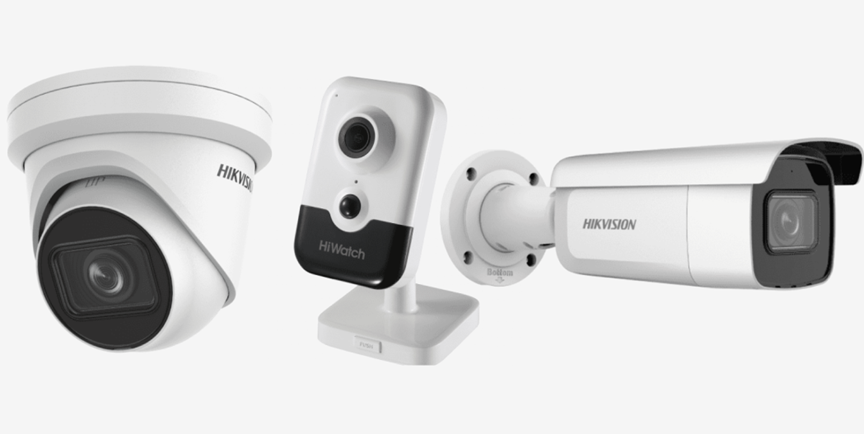
HiWatch DS-I214W(C), 2 mm
This indoor Wi-Fi example was listed with a 2 MP sensor, a 2 mm lens, roughly 98-degree coverage, a −10 to 40°C range, a 32 kb/s to 8 Mb/s video range, card support up to 256 GB, and consumption up to 6.5 watts. The source describes EXIR illumination around ten meters and QR or software-based setup.
The original simultaneously called the camera 2 MP and “only HD,” which is too imprecise to establish its output modes. Check the exact resolution list. More importantly, its reported IP20 classification provides no water protection. It should not be described as effective in difficult outdoor weather simply because it has infrared LEDs.
A small office, room, or shop may benefit from a compact indoor camera, but no single model guarantees complete security for a large business center. System coverage, supported storage, access control, and response procedures determine suitability. The absence of an Ethernet data run can simplify placement, while power, Wi-Fi capacity, and account support still need planning.
Mi 360° Home Security Camera 2K Pro
The source contradicted itself by claiming both dual-band Wi-Fi and no 5 GHz support. Xiaomi's official FAQ confirms 2.4 and 5 GHz support for the 2K Pro. It also describes a Bluetooth gateway function, two-way audio, indoor use, and a powered connection rather than battery operation. Do not confuse this Pro model with a differently specified 2K model.
The gateway function links supported Bluetooth devices; it does not replace every kind of home-network gateway. The original promise of faultless baby-cry or dog-bark recognition was unsupported. Treat sound alerts and human detection as assistance that needs validation, especially where missing an event would have serious consequences. The 360-degree label refers to motorized coverage, not simultaneous observation in every direction.
HiWatch DS-I259M(C)
The final example was presented as a rugged camera for entrances, parking areas, and outdoor monitoring. The original used a malformed copyright symbol in the suffix and made broad claims about replacing several 4 MP cameras, surviving severe weather, and providing improved night imaging. Those claims were not supported by a complete specification or measured coverage plan.
The useful requirement is to check the exact model, lens view, resolution, illumination, environmental rating, and documented impact resistance. One camera can replace several only when its actual views and retained detail meet the same tasks. A vandal-resistant housing does not protect an exposed cable, prevent all obstruction, or ensure a useful view during heavy snow.
Compare the complete recording system
Card capacity alone does not establish adequate retention. For continuous recording at 4 Mb/s, a camera produces roughly 43.2 decimal GB per day before overhead. A nominal 128 GB card therefore offers less than three days at that rate, with usable capacity and other data reducing it further. Event-only recording can last longer, but depends on trigger frequency and whether missed triggers are acceptable.
For larger sites, consider an NVR or managed server, protected power, storage-health alerts, suitable backups or export procedures, and a retention policy. A card inside a stolen camera may disappear with it. Conversely, a recorder with no monitoring can fail unnoticed. Reliability comes from the full workflow, including finding and exporting the desired incident.
Compare total cost: cameras, mounts, power, network equipment, licenses, subscriptions, storage, installation, and support. Voice-assistant integration can be convenient but does not replace a recording system or access-control policy. Verify the supported region, account requirements, and what information the integration exposes.
Use the named examples to understand categories and specification traps, then evaluate current security cameras and surveillance systems against a written site requirement. Confirm the exact revision and obtain sample recordings under realistic lighting and movement. That provides a stronger basis for selection than a broad claim that one brand or country produces the best camera for every situation.
Related products from Safsale
Continue from Academy guidance to live equipment and components available on Safsale.
 Reolink RLC-823A 8 Megapixel Outdoor PTZ IP Camera, 2.7-13.5mm LensView product
 Reolink Argus-2e Indoor/Outdoor Wire Free Smart Security Camera 1080pView product
 Hanwha Vision SND-6084 2MP Full HD Day/Night IP Dome Camera, 3-8.5mmView product
 Hikvision ECI-T24F2 4 Megapixel Network IR Outdoor Dome Camera, 2.8mm LensView product