
IP CAMERAS WITH PoE POWER
CLASSIFICATION AND STANDARDS
EQUIPMENT
ADVANTAGES AND DISADVANTAGES
Power over Ethernet (PoE) is a technology enabling IP cameras and related devices to receive power over the same Ethernet cable (UTP category 5 or higher) used for data transmission.
This method provides a constant voltage of 48 volts with a power range of 15.4 to 25.5 watts, depending on the standard, and a current of 400 mA. Using PoE does not compromise video quality or introduce interference because:
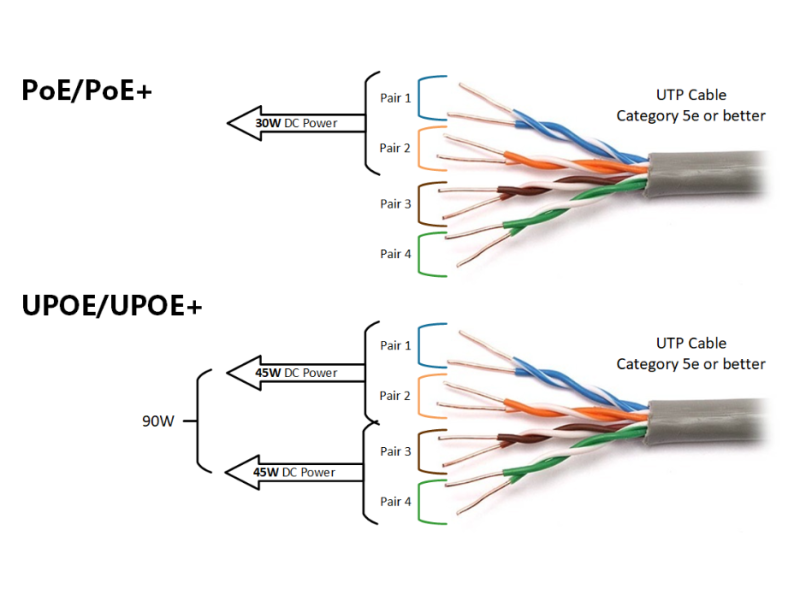
- Separate Power Lines: Electricity is transmitted through pairs of wires not used for data. Ethernet’s 100Base-TX standard reserves only two of the four pairs in a UTP cable for data.
- High-Frequency Transformers: Power is isolated from the data flow using transformers, ensuring the video signal remains unaffected.
POWER SUPPLY TO IP CAMERAS
The PoE power supply connects to the RJ-45 port of an IP camera only if the camera supports PoE. If you accidentally plug a non-PoE camera into a powered port, the camera will remain safe and operational.
Power Delivery Steps:
Compatibility Check:
The PoE adapter tests the device's resistance using a low test voltage (up to 10 volts). Cameras with resistance between 19-25.3 kOhms are recognized as PoE-compatible.Power Classification:
Devices are categorized into four power classes based on their energy needs. If a device exceeds allowable power limits, it is disconnected. For example:- Class 0: Up to 4.5 W
- Class 1: 3.84–6.49 W
- Class 2: 6.49–12.95 W
- Class 3: Up to 15.4 W
Full Power Delivery:
After classification, the system gradually supplies full power (48 volts). The PoE adapter monitors the current draw to prevent overloading.
PoE STANDARDS
Widely adopted standards include:
- IEEE 802.3af: Supplies 48V at up to 15.4 W, using spare wire pairs.
- IEEE 802.3at (PoE+): Supplies up to 25.5 W by leveraging all wire pairs, including those used for data transmission.
Power Transmission Methods:
- Type A: Supplies power via pairs that also carry data (phantom power).
- Type B: Uses unused wire pairs for power transmission.
Most IP cameras are compatible with either method and can accept reversed polarity without issue.
PoE EQUIPMENT
PoE devices fall into two categories:
- PSE (Power Sourcing Equipment): Devices like PoE switches or injectors supplying power.
- PD (Powered Devices): Devices like IP cameras receiving power.
For robust systems, select PoE switches based on:
- Total port power.
- Maximum power per port.
Most PoE switches power only a portion of their ports. If choosing an injector, prioritize models with galvanic isolation and protection against surges.
ADVANTAGES AND DISADVANTAGES
Benefits of PoE:
- Simplified Setup: One cable handles power and data, saving on materials and installation costs.
- Cost-Effective Upgrades: Existing infrastructure can be reused for PoE-enabled systems.
- Increased Safety: Eliminates reliance on external power sources, enhancing security.
- Remote Reboot Capability: Devices can be restarted remotely, avoiding physical maintenance trips.
Disadvantages:
- Higher cost compared to traditional systems.
- Increased power demands may require upgrading electrical infrastructure.
PoE is ideal for medium to small-scale indoor surveillance systems. However, outdoor setups with additional components (e.g., IR lighting, heating elements) often exceed PoE's power limits, requiring supplementary power sources
Related products from Safsale
Continue from Academy guidance to live equipment and components available on Safsale.
 Weldex WDP-84ML2M-BK 2 Megapixel Full HD IP Mullion Camera, POE, Black HousingView product
  TP-Link Tapo-C325WB 4 Megapixel Outdoor Security Wi-Fi Camera with 4.58mm LensView product
  Digital Watchdog DWC-MPA20M 2MP Full HD Outdoor Day/Night Vandalproof Dome CameraView product
  Reolink TrackMix WiFi 4K Dual-Lens Wireless PTZ CameraView product