
How a Bridge Rectifier Works: Circuit, Function & Applications
1. What Is a Bridge Rectifier?
A bridge rectifier is a circuit composed of four diodes that converts alternating current (AC) into direct current (DC). It is commonly used in power supplies to provide stable DC voltage from an AC source.
Converts AC to DC (full-wave rectification)
Utilizes both halves of the AC cycle
Provides a smoother and more efficient output than half-wave rectifiers
A standard bridge rectifier circuit consists of:
✔ Four diodes (arranged in a bridge configuration)
✔ AC input terminals
✔ DC output terminals
2. Bridge Rectifier Circuit Diagram
Basic Bridge Rectifier (Single-Phase)
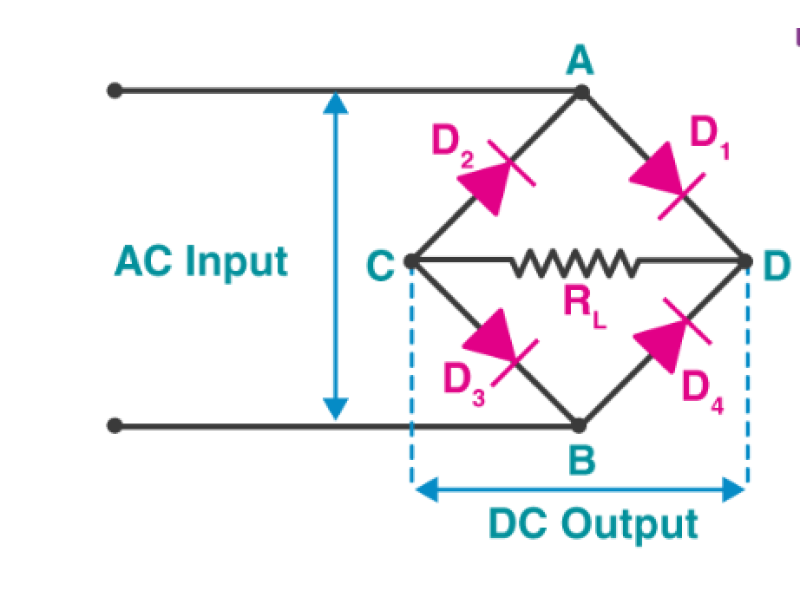
The standard single-phase bridge rectifier circuit is shown below:
Components:
✔ Diodes (D1, D2, D3, D4) – Conduct current in specific directions
✔ AC input (A, B terminals) – Connected to a transformer or AC source
✔ DC output (C, D terminals) – Provides rectified voltage
Working Principle:
1. Positive Half-Cycle:
- D1 & D3 conduct (allowing current flow)
- D2 & D4 block current
- Current flows from A to B, generating a positive output
2. Negative Half-Cycle:
- D2 & D4 conduct
- D1 & D3 block current
- Current still flows in the same direction on the output
Result: The rectifier converts AC into pulsating DC, maintaining a consistent polarity.
3. Three-Phase Bridge Rectifier
For higher efficiency, a three-phase bridge rectifier is used. This is commonly found in industrial power supplies and alternators.
Key Features:
✔ Uses six diodes instead of four
✔ Provides lower ripple voltage
✔ More efficient for high-power applications
Working Principle:
Each phase contributes power in a 120-degree shift, reducing voltage ripple and improving efficiency.
4. Bridge Rectifier with a Capacitor Filter
Since rectifiers produce pulsating DC, a capacitor (C) is often added to smooth the output.
How It Works:
✔ Capacitor Charges during peaks
✔ Releases Stored Energy during voltage drops
✔ Reduces Ripple, making DC more stable
Applications:
✔ Power Adapters (e.g., phone chargers)
✔ DC Power Supplies
✔ Battery Charging Circuits
5. Real-World Applications of Bridge Rectifiers
✔ Power Supply Circuits – Converts AC mains to DC for electronics
✔ Battery Chargers – Converts AC for efficient charging
✔ Motor Drive Circuits – Provides DC power for industrial motors
✔ Welding Equipment – Delivers stable DC current
6. Key Takeaways
✔ A bridge rectifier converts AC to DC using four (or six) diodes
✔ It is more efficient than a half-wave rectifier
✔ A capacitor filter smooths out the output voltage
✔ Used in power supplies, battery chargers, and industrial applications
A bridge rectifier is an essential AC-DC conversion component, ensuring stable and efficient power delivery for countless electronic applications! ?
Related products from Safsale
Continue from Academy guidance to live equipment and components available on Safsale.


