
Testing a Diode with a Multimeter: Methods and Interpretation
1. Why Test a Diode?
A diode conducts current in only one direction. To determine if a diode is working properly, we test:
✔ Forward bias (should conduct)
✔ Reverse bias (should block current)
A faulty diode may be:
❌ Open (no conduction in both directions)
❌ Shorted (conducts in both directions)
❌ Leaking (partially faulty, allowing some reverse current)
Using a multimeter, you can easily diagnose a diode’s condition in just a few steps.
2. Testing Methods: Resistance Mode & Diode Test Mode
Multimeters offer two ways to test diodes:
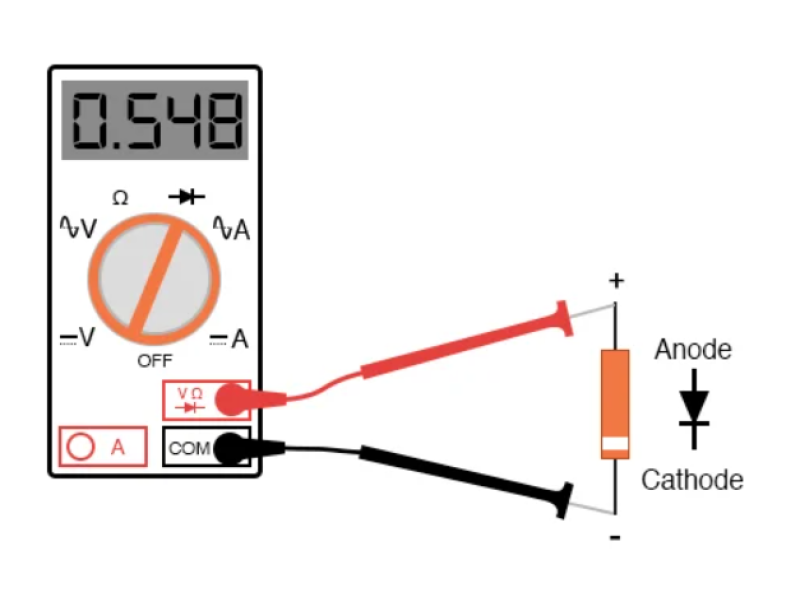
1. Diode Test Mode – Measures voltage drop in forward direction
2. Resistance Mode – Measures resistance in forward and reverse bias
3. How to Test a Diode Using Diode Mode
✔ Step 1: Set your multimeter to the Diode Test Mode (symbol: ▶|).
✔ Step 2: Connect the red probe to the anode (+) and black probe to the cathode (-).
✔ Step 3: Observe the reading:
Expected Readings for a Good Diode:
✔ Silicon Diodes: 0.5V - 0.7V
✔ Schottky Diodes: 0.2V - 0.3V
✔ Germanium Diodes: 0.25V - 0.4V
If the display shows ‘1’ (OL or Overload), the diode is open and faulty.
4. Reverse Bias Testing (Diode Mode)
✔ Step 1: Reverse the probes (red to cathode, black to anode).
✔ Step 2: Observe the reading:
Expected Readings:
✔ "1" (OL/OVER) means the diode is working (blocking current).
✔ Any voltage reading means the diode is faulty (leaking current).
5. How to Test a Diode in Resistance Mode
If your multimeter does not have Diode Mode, use the Resistance (Ω) mode.
✔ Step 1: Set the multimeter to a high resistance range (e.g., 2MΩ).
✔ Step 2: Connect the red probe to the anode (+) and black probe to the cathode (-).
✔ Step 3: Observe the resistance reading:
Expected Readings for a Good Diode:
✔ Forward Bias (Anode to Cathode): Low resistance (hundreds to thousands of ohms)
✔ Reverse Bias (Cathode to Anode): Very high resistance (OL or Overload)
❌ If resistance is low in both directions, the diode is shorted.
❌ If resistance is high in both directions, the diode is open or defective.
6. Common Diode Faults & What They Mean
OL in Both Directions (Open Circuit) → Diode is dead
0Ω in Both Directions (Short Circuit) → Diode is shorted
Forward Voltage Drop Too High (>1V for silicon diodes) → Possible damage
Reverse Bias Conducts (Leakage) → Diode is faulty
7. Conclusion: Key Takeaways
✔ A working diode conducts in one direction and blocks in the other.
✔ Use the diode test mode for accurate results (voltage drop check).
✔ Use the resistance mode if diode mode is unavailable (low vs. high resistance).
✔ Check datasheets for exact voltage drop values for different diode types.
✔ Replace faulty diodes immediately to prevent circuit failures.
Testing a diode with a multimeter is quick and easy, helping you diagnose electronic issues with precision! ?
Related products from Safsale
Continue from Academy guidance to live equipment and components available on Safsale.


